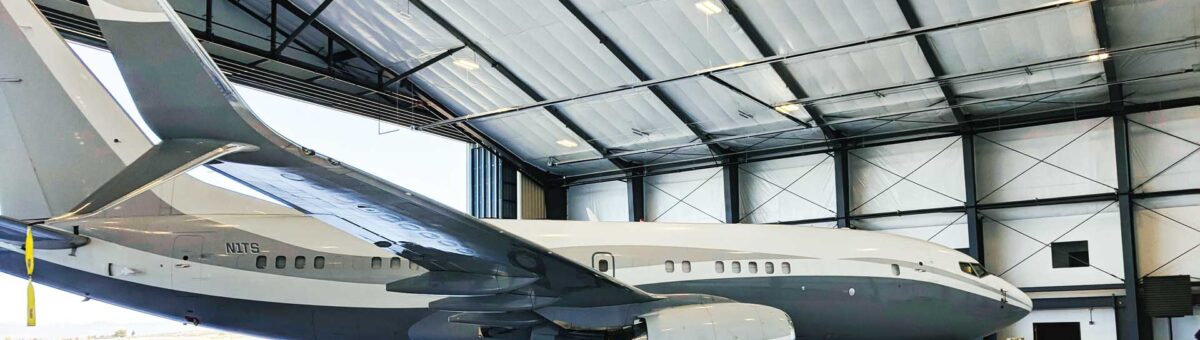
Aircraft Hangars – The Making of a Strategically Solid Investment
Hangar Ownership Typically Affords Many Tangible Advantages
Owning an aircraft involves major capital outlay and is a big commitment. Aircraft are costly to acquire, maintain, insure, and operate. Whether you are a private aircraft owner with one or two aircraft or a big corporate flight department handling multiple jets, hangar ownership typically delivers a multitude of advantages. This includes protecting and maintaining asset value, improving operational efficiency, cost savings, greater revenue potential, and overall peace of mind.
Below, we explore the ways in which owning a hangar generates true value, followed by a look at how to assess ROI, and then a look at the historical evolution of hangars and how the future may make these unique structures more cost-effective and reliable.
The Ubiquitous Aircraft Hangar (Key Advantages)
- Protective Benefits
Aircraft parked outdoors are subjected to intense UV radiation, moisture, hail, corrosion (particularly in coastal or humid regions), wind-blown debris, and extreme temperature variations. These factors accelerate wear and increase maintenance costs—not only cosmetic issues like paint fading, but also more serious structural or avionics problems. A properly designed and constructed hangar reduces that exposure, leading to lower repair costs, fewer unscheduled maintenance events, and a longer useful airplane life. - Improved Security
Aircraft hangar owners control access, essentially reducing the risk of vandalism, theft, and unauthorized use. These security advantages typically result in reduced insurance premiums. - Operational Efficiency and Convenience
Having an aircraft co-located within a hangar simplifies logistics, including pre-flight checks, routine maintenance, cleaning, loading passengers or cargo, etc. Delays resulting from hazardous weather or lack of access are minimized. Also, for corporate flight departments, where scheduling, readiness, and reliability are critical, having a hangar facility reduces “aircraft on ground” (AOG) events. - Cost Savings Over Time
While building or buying a hangar involves significant upfront expenditure, over time, many recurring costs are reduced or avoided completely: rental or lease payments, premium penalties for outdoor storage, accelerated maintenance due to environmental damage, and—potentially—higher insurance costs. Also, a hangar allows better control of when and how maintenance is performed, which can reduce overtime or emergency costs. - Revenue Generation Potential
When a hangar has more space than is needed, or is built with modularity in mind, excess capacity can easily be leased to other aircraft owners or used to support related services (maintenance shop, storage of parts, etc.). This transforms part of a hangar investment into a reliable revenue stream. - Asset Appreciation & Resale Value
Real estate historically appreciates. A high-quality hangar in a good location (airport with good traffic, experiencing steady growth, constrained hangar inventory) increases in value. Also, stored aircraft are in better condition and retain value more significantly, demanding a higher resale price. - Insurance & Tax Advantages
Many insurers offer significantly lower premiums for hangar-protected aircraft. Additionally, ownership can offer tax benefits, including depreciation, interest deductions on financing, and potentially favorable treatment of property taxes, depending on the location.
When deciding whether hangar ownership is financially advantageous, it’s best to “model” ROI metrics. Key components include:
Example of ROI Calculation – Running the Numbers
Here is a simple illustrative hypothetical example:
- Let’s assume you build a relatively modest hangar for a midsize corporate jet. Cost: $1.5 million for land, structure, doors, climate control, etc. Operating costs: $20,000/year. Avoided costs of renting a similar hangar: $60,000/year. Plus, maintenance savings and insurance savings about $10,000/year. Revenue from leasing spare capacity: $15,000/year. So net benefit in year 1 (excluding depreciation/financing):
Avoided + savings + revenue − operating = $60,000 + $10,000 + $15,000 − $20,000 = $65,000. - If the cost of capital (or discount rate) is, say, 6%, that’s $90,000/year equivalent. But net benefit of $65,000 gives payback in ~23 years (without accounting for appreciation of hangar and of aircraft). If you include value appreciation and increasing rents/cost inflation, plus possibly tax incentives or grants, the ROI could be more favorable. If you own for 30 years or more, returns can improve significantly.
- If revenue potential is higher (e.g., large hangar, part used as an MRO shop), or if the rental market in your region is strong, payback could be much sooner (e.g., 10‑- 15 years).
Flight departments tend to prefer models where the hangar serves multiple functions (storage, maintenance base, operations center), which increases utilization and return.
Historical Context: Hangars – How it all Started
Understanding history helps put both cost metrics and the future into a much better perspective.
- Early Hangars (Pre‑WWI / WWI era): Initially, they were very basic — canvas, timber, and relatively small. The role was purely protective, providing shelter from rain, wind, and other adverse weather conditions. Canvas or wooden tents were used in early military aviation, sometimes in temporary or semi-permanent configurations.
- Interwar and WWII Period: As aircraft became bigger, the complexity of hangars quickly evolved. Steel framing, reinforced concrete, large sliding or bifold doors, and expanded size (wing spans, tail height) became necessary. Wartime logistics and the need for rapid maintenance made durability, fire suppression, and material strength more important.
- Postwar / Jet Age: The introduction of jet aircraft and commercial aviation expansions necessitated hangars with larger clear spans, advanced climate control, maintenance bays, tooling, and lighting. Airports developed large MRO (Maintenance, Repair, Overhaul) facilities. Hangars ceased to be simple shelters; they fast became industrial-scale properties with high building and operating standards.
- Modern Era: Emphasis on efficiency, sustainability, incorporating modern materials, integration with avionics / diagnostic infrastructure, LEED or green building certification, security controls, and sometimes automation in hangar operations. Fabric or tensile structures are being used in certain places to reduce cost and speed construction.
The Future: Trends Making Hangar Ownership More Practical & Affordable
Several trends are converging that will likely help reduce costs while improving ROI, and make hangar ownership more accessible and practical:
- Alternative Building Materials & Structures
Fabric or tensile hangars, modular steel or prefabricated structures, hybrid materials. These reduce construction time and cost. Tensile fabric hangars may have lower structural cost, less material weight, faster assembly. - Energy Efficiency & Net Zero / Green Design
Better insulation, LED lighting, daylighting, solar panels on roofs, efficient HVAC, rainwater capture. These reduce ongoing operational costs. As energy costs increase, efficiency becomes more critical. Incorporation of BMS (Building Management Systems) helps monitor and dynamically control climate, lighting, etc. - Smart Technologies and Automation
Sensors for humidity, temperature, structural health; automated doors; improved security (biometrics, CCTV, AI monitoring); predictive maintenance tools that help schedule work. These reduce labor costs, prevent damage, and increase safety. - Flexible / Multi-Use Design
Hangars designed not just for storage, but also for maintenance shops, avionics, interiors, and refurbishment; spaces that can switch roles. Also, designing with surplus capacity so owners can lease out unused portion. Multi-use facilities may spread costs across functions. - Evolving Aircraft Types
Electric aircraft, urban air mobility (UAM), eVTOLs, and unmanned aerial systems will likely require different types of hangar infrastructure, including charging, battery storage, and safety systems. But lighter aircraft may allow smaller hangars or less heavy structures, potentially lowering cost. - Regulation, Zoning, and Incentives
In many jurisdictions, there may be incentives (tax credits, grants) for green building, energy-efficient design, or using sustainable materials. Zoning reforms that make hangar building easier or faster can reduce permitting costs and delays. Airport authorities may develop hangar pads to encourage private investment. Additionally, longer-term leases with favorable terms ensure that owners don’t fear losing improvements when leases expire. - Market Pressures & Demand
Hangar inventory is constrained in many regions, especially around desirable airports. That increases hangar lease rates and land value near airports, improving potential upside on hangar real estate. High demand means that well-placed hangars can command premium returns.
Risks, What to Watch, and Best Practices
To make hangar ownership a solid investment, it is best to be aware of and consider the following:
- Location: Proximity to airport infrastructure, taxiways, ease of access, demand for hangar space locally. A hangar at an airport with low demand or restrictive zoning may underperform.
- Land Ownership vs Lease: Many hangars are built on leased land (airport property). The lease term, renewal terms, fees, and whether improvements revert to the airport at the end of the lease—all of that greatly affects long-term value. If improvements revert or land lease ends on bad terms, the owner may lose value.
- Building Standards & Future Proofing: Doors and ceiling height must accommodate current and future aircraft. The electrical infrastructure must support modern avionics and potential charging for electric aircraft in the future. Insulation, fire suppression, and climate control are built to code. Over‐building vs under‐building trade-off.
- Operating Costs: Underestimating ongoing maintenance, utilities, especially in harsh climates. Also, ensure insurance costs for the hangar itself (liability, fire, etc.) are included.
- Regulatory & Tax Changes: Local tax assessments, zoning, and environmental regulations can change over decades, affecting cost or use.
- Occupancy & Utilization: Revenue potential depends on whether there is spare capacity; if you build too large for your needs, the extra costs may outweigh the revenue unless demand is strong.
Expected ROI Timeframes & Benchmarks
While ROI depends heavily on location, aircraft size, building cost, and utilization, some generalized benchmarks are:
- Small General Aviation Single Aircraft Owner: A modest hangar for a single piston or light twin aircraft may take 10‑- 20 years to pay back when considering avoided rental cost, maintenance savings, and insurance reductions. If you include appreciation, tax benefits, and increased resale value, the effective ROI may be considerably better.
- Corporate Flight Departments or Operators with Multiple Aircraft: Because usage is higher, avoidance of downtime can be very valuable; also, revenue from providing maintenance or leveraging facilities can accelerate payback. In many cases, such departments may see payback in 8‑- 15 years or sooner, assuming they are well utilized.
- With Spare Capacity / Leased Space: If part of the hangar can be leased or used for revenue, or if the hangar supports additional business lines (maintenance, avionics, interiors), ROI can be significantly better. In some “best cases,” a hangar might pay for itself in under 10 years.
History Plus Evolution, Summarized
- Origins: Earliest hangars were simple canvas or wood shelters (e.g., Bessonneau hangars in WWI) designed merely to keep aircraft out of rain or direct sun.
- Mid‑20th Century: As aircraft became faster, larger, and more complex (jet age, large U.S. military bombers, landmark commercial aircraft), hangars evolved in scale: larger clear spans; stronger materials; integrated infrastructure. Post-war reconstruction and aviation industry expansion drove much of this growth.
- Late 20th / Early 21st Century: Focus shifted toward efficiency, safety, support for maintenance and overhaul, environmental control, energy efficiency, and regulatory compliance. Hangar design diversified (T‑hangars, nested hangars, fabric/tensile structures, etc.). Out of necessity, location near airports, ground infrastructure, and permitting complexities became more important.
The Path Ahead: Why Hangars Will Become More Affordable & Practical
Looking into the future, developments are likely to make hangar ownership a more accessible and practical option.
- Modular/Prefabricated Construction: Off-site manufacturing, prefabricated panels, flexible materials—these reduce labor cost, site overhead, time to build, and waste. Fabric/tensile or hybrid systems can be much quicker to erect.
- Economies of Scale & Standardization: As demand increases (especially from regional operators, eVTOL, urban air mobility), more standard hangar designs will emerge that can be replicated, reducing cost per square foot.
- Incentives for Sustainable Design: Governments and airports may increasingly offer grants, tax incentives, or favorable leasing of land for hangars that meet energy-efficient or green building standards. This may pay back via reduced energy costs and regulatory advantages.
- Changing Aircraft Technologies: Electric aircraft may reduce requirements for large fueling infrastructure, vibration isolation, or heavy structural door strength in some cases. Some battery systems reduce operating costs. Also, smaller aircraft (drones, eVTOL) may open demand for smaller, more flexible hangars, possibly for shared use.
- Improved Financing and Ownership Models: Financial products specifically geared to hangar construction or acquisition may become more common (loans, leases, shared ownership). Additionally, public-private partnerships, such as airport authorities offering long leases with favorable terms, may help reduce risk.
- Innovation in Maintenance & Remote Monitoring: With IoT, predictive maintenance, automated systems, much of the cost of maintaining not just the aircraft but also the facility can be better managed, reducing surprises and lower cost over time.
- Supply Chain & Material Advances: As construction materials improve (lighter, stronger, cheaper, more durable, less maintenance), costs of building and maintaining hangars will fall. Standardization in components (doors, panels, lighting systems) will also reduce cost.
Trusted Advice for Decision‑Makers
For corporate flight departments or owners considering whether to own a hangar:
- Perform a full cost/benefit analysis specific to your airport(s), aircraft types, climate, rental costs in your area, and foreseeable growth.
- Plan for future needs: Are you likely to need more space, different-sized doors, enhanced climate control, expanded utilities, etc.? It’s almost always more expensive to retrofit than to anticipate.
- Understand the land/lease terms: If you own the land, great. If leasing, know what happens at lease end. Is ground rent stable? Will improvements revert to the lessor? Are there renewal terms?
- Factor in all ongoing costs: Utilities, maintenance of building (door mechanisms, structural integrity, roof, etc.), insurance, taxes, and compliance with changing codes.
- Maximize utilization: If possible, design for multiple uses—storage, maintenance, third-party leasing. Seek out revenue opportunities.
- Monitor regulatory and energy trends: Energy codes, environmental regulations, and building codes may evolve. Being ahead of the curve (for example, using solar panels or high-efficiency lighting) may help avoid future retrofit costs.
Final Analysis
Aircraft hangars are more than just walls and a roof: they are critical strategic assets. For aircraft owners and corporate flight departments that demand the best in asset protection, operational readiness, cost control, and longer equipment lifespans, a well-designed and constructed hangar represents a key investment. The ROI may not always be immediate—depending on the region, size, and usage—but over a medium to long horizon (10‑- 30 years), benefits in avoided costs, revenue, reduced downtime, improved resale value, and asset preservation can easily justify the initial investment.
With technological, regulatory, and material trends pointing toward lighter, more efficient, greener, and modular designs (plus possibly better financing and incentives), hangar ownership is likely to become even more practical and financially attractive in the years to come. For any organization or individual with aircraft that will be used long-term, hangar ownership deserves serious consideration as part of an overall asset management strategy.