Fly Into Oklahoma and Learn About the State’s Rich Aviation History
OK – Oklahoma has a rich aviation history, and it started in 1910 when Charles Willard flew his powered airplane, a Curtiss Pusher, during an exhibition. This was six years after the Wright Brothers’ first flight and 2.5 years after Oklahoma officially joined the union. From there, aviation quickly advanced in the state. In 1919, the first Oklahoma airport was established, and in the 1920s, The state received its first airmail route. Advancements continued through World War II and beyond. Today, the state is home to the Science Museum Oklahoma, the Tulsa Air and Space Museum, the Ninety-Nines Museum of Women Pilots, and the Woolaroc Museum & Wildlife Preserve. Let’s take a look at all the incredible aviation innovations and history in these three establishments and why you just might want to make Oklahoma your next fly-in adventure.
Start Your Vacation by Landing at Wiley Post Airport (PWA) in Oklahoma City
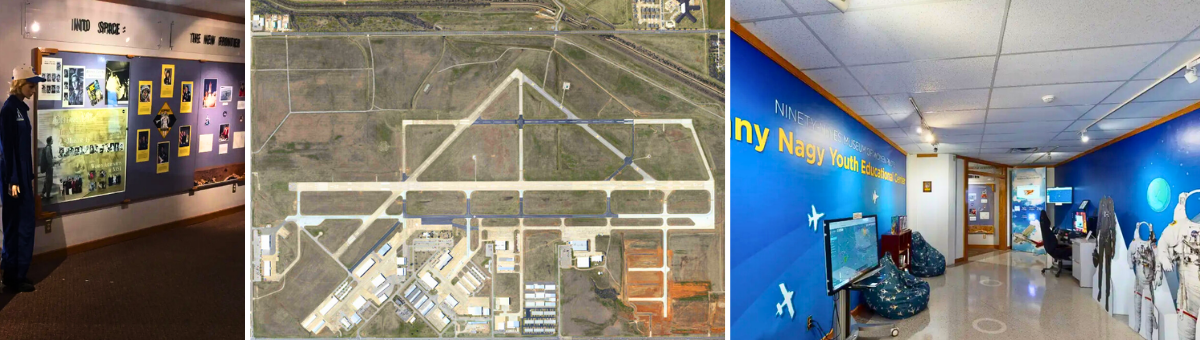
Wiley Post Airport (PWA) opened in 1943. It is open to the public and has a control tower. Jet-A+ and 100LL are available. Pilots can order bottled and bulk high and low oxygen, and the airport offers major airframe and powerplant services. Hangars and tiedowns are available for parking.
Runway 17L/35R is 7,199 feet long and 150 feet wide. Runway 17R/35L is 5,002 feet long and 75 feet wide. Runway 13/31 is 4,214 feet long and 100 feet wide. Runways 17L/35R and 17R/35L are in good condition, while Runway 13/31 is in excellent condition.
Science Museum Oklahoma
Wiley Post Airport is just 12 miles from Science Museum Oklahoma, which is in the historic Kirkpatrick Center. The Science Museum is an AAM-accredited institution and a Smithsonian affiliate. The museum has a focused interest in aviation, naval, and space technology. Their exhibits include the Main Science Gallery, which contains a plethora of hands-on displays, including a resonant pendulum and a Segway Park.
Once you’ve explored the Main Science Gallery, you may want to head over to Destination Space. This exhibit includes a Mercury capsule simulator, rocket engines, and Apollo artifacts.
After exploring everything in Destination Space, take a walk over to the Oklahoma Aviation and Space Hall of Fame exhibit, where you can honor the aviation pioneers and adventurers who made powered flight and space exploration possible.
Next, head over to the Aviation Gallery. This is where you’ll find examples of everything from Leonardo da Vinci’s early sketches to the biplanes used in WWI to modern jet aircraft. It’s sure to be the highlight of your museum experience.
Once you’ve had your fill of aviation and space technology, meander over to Pavlov’s Cafe and fill your stomach. The cafe offers pizza, burgers, fries, and coffee, as well as other great lunch and snack options.
Ninety-Nines Museum of Women Pilots
The Ninety-Nines Museum of Women Pilots is 14 miles, or 22 minutes, from Wiley Post Airport on Amelia Earhart Drive. It features 5,000 square feet of exhibits where patrons can view artifacts and exhibits from the world’s most skilled and adventurous female aviators.
The museum’s name is derived from the 99s, which started in 1929 as an international organization founded by 99 female pilots for female pilots. The goal of the organization is to facilitate the “advancement of aviation through education, scholarships, and mutual support while honoring our unique history and sharing our passion for flight.”
The on-site exhibits at the museum include A Timeline of Historic Flights by Amelia Earhart, the Penny Nagy Youth Education Center, the Jerrie Cobb Into Space exhibit, the Marion P. Jayne Collection, the 1929 Powder Puff Derby, Women Aviators of WWII, and WASP, which often stands for Women Airforce Service Pilots. However, they’re also sometimes referred to as Women’s Army Service Pilots or Women’s Auxiliary Service Pilots.
In addition to their on-site exhibits, they also have some special collections, including the H. Glenn Buffington Collection and Jacqueline Cochran Collection. The H. Glenn Buffington Collection pays homage to H. Glenn Buffington, who was male. However, he was an amazing supporter of female aviators and amassed a massive collection of aviation artifacts. Jacqueline Cochran began taking flying lessons in 1932, and by 1941, she was training other women in the British Air Transport Auxiliary.
Fly Into the Tulsa Riverside Airport and Enjoy a Day at the Tulsa Air and Space Museum
The Tulsa Air and Space Museum is located next to the Tulsa International Airport. If you don’t want to drive the 118 miles from Wiley Post Airport, you can fly your airplane from PWA to Tulsa Riverside Airport (RVS). RVS was activated in 1958. It’s open to the public and has a control tower. The airport offers 100LL, Jet-A, and Jet-A+. If your airplane needs repairs or an annual, major airframe and power plant services are available. Tulsa Riverside Airport offers parking via tiedowns and hangars, and bottled oxygen is available. Runway 1L/19R is 5,101 feet long and 100 feet wide. Runway 1R/19L is 4,205 feet long and 100 feet wide, and Runway 13/31 is 2,639 feet long and 50 feet wide.
The Tulsa Air and Space Museum
The Tulsa Air and Space Museum was founded in 1998. At that time, it was located in an old 1940s hangar on the campus of the Spartan School of Aeronautics. It remained there until 2005, when it moved to its current location at the Tulsa International Airport in the Sherman and Ellie Smith Hangar One.
The Helmerich Exhibit Hall is home to several exhibits, including a Spartan Executive, which was manufactured in the 1940s as an airplane for C-suite executives and CEOs, a Grumman F-14A Tomcat, which were used during the Cold War and in the Gulf War, Iraq and Afghanistan, an American Airlines MD-80, which was used for passenger travel, and a Rockwell Ranger 2000, which was designed to be a military training aircraft. In addition to the aircraft, there’s also a Tuskegee Legacy Exhibit, a Shuttle Simulator, the Ray Booker Flight Lab, which allows visitors to go through flight training, and a Manned Maneuvering Unit (MMU), a nitrogen-propelled backpack that lets astronauts move in microgravity. For those who want even more, the Tulsa Air and Space Museum lets you design your own aircraft simulator.”
Once you’re finished exploring all of the exhibits, take a walk over to the Planetarium. They have shows from 11 AM until 3 PM. A few of the show’s topics include the Earth, Moon, and Sun, the universe, black holes, and NASA. To ensure that there is space and the show you want to watch is playing, they recommend calling ahead of time. It’s important to note that the tickets must be purchased at the museum and not in the Planetarium lobby.
Fly up to the Bartlesville, OK Municipal Airport (BVO) and Visit the Woolaroc Museum & Wildlife Preserve
From the Tulsa Air and Space Museum, you might want to fly up to the Woolaroc Museum & Wildlife Preserve and land at the Bartlesville, OK Municipal Airport (BVO), which is just a 14-minute drive to the museum. Rental cars are available in Bartlesville and can be delivered to the airport.
The Bartlesville, OK Municipal Airport was first activated in 1938. It’s open to the public and does not have a control tower. Jet-A+ and 100LL are available, and low bottled oxygen can be purchased. If your airplane needs repairs, they have major airframe and powerplant services available. Runway 17/35 is 6,850 feet long and 100 feet wide. The runway and markings are considered to be in good condition.
Woolaroc Museum & Wildlife Preserve
The Woolaroc Museum is well known for its Western art and artifacts, but did you know it also contains aviation exhibits? It does. Specifically, it has the Woolaroc Aircraft, which was a Travel Air 5000 monoplane that was sponsored by Frank Philips, and it won the Dole Air Race in 1927. In fact, it’s the only surviving aircraft from that fateful race.
In fact, the museum was initially just a place for Frank to store the Woolaroc aircraft. However, it quickly grew to house other aviation artifacts. Today, the 3,700-acre property is home to a museum, wildlife preserve, lodge, mountain man camp, animal barn, and numerous hiking trails. If you love airplanes, nature and Western history, you’ll love visiting the Woolaroc Museum & Wildlife Preserve.
If you’re looking for a vacation that allows you to get some cross-country flight time and learn about aviation history, a trip to Oklahoma may just be your idea of a fantastic fly-in vacation. There’s plenty to see and do, and plenty of small- and medium-sized airports to discover.